Guide
Carpenter, cargo or five pocket: what the cut actually changes
Three pocket plans, three different jobs. What each one carries, what it costs you, and which one is wrong for the work you are doing.
Strip the marketing off a pair of work trousers and what is left is a pocket plan. The fabric matters, the fit matters, but the thing that decides whether a pair works on a given day is where it lets you put your hands and your tools. Three plans cover almost everything in this range, and they are not interchangeable.
This catalogue currently carries 78 colourways. 13 of them are cut as carpenters, 10 as cargos in full length, 26 as cargo shorts, 8 as five pocket jeans and the rest as plain twill and canvas. We did not choose those proportions. They follow what we sell.
The carpenter cut
You can pick a carpenter pair out across a site. There is a loop on the outside of one leg for a hammer, a flat patch pocket on the other for a rule, and usually a utility pocket sitting on the thigh. The maker states reinforced seams and double stitching on these styles, and the loop is the part that gets the abuse.
What the plan is good for is carrying things that are long and hard. A framing hammer hangs off the loop without swinging into your knee. A folding rule sits flat against the leg instead of jamming into a pocket corner. A pencil, a chalk line and a pair of snips go in the utility pocket and stay visible.
What it costs you is comfort in a vehicle and comfort on a ladder. The loop catches on rungs, and the patch pockets sit exactly where a seat belt crosses. If your day is mostly driving between jobs, the carpenter plan is working against you for most of it.
- Best for: framing, joinery, anything with a hammer in hand for hours.
- Worst for: long drives, ladder work, crawling in a loft.
- Watch: the hammer loop is the first thing to fail on a cheap pair. Ours are stitched at both ends, which is the maker's own note.
From the range
Carpenter pairs in the range

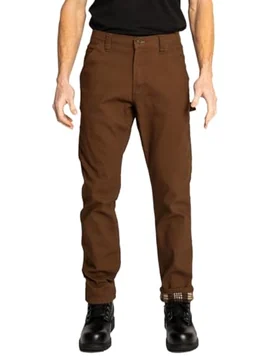
Carpenter Fleece Lined Canvas Stretch Performance Pants, Regular Fit, Utility Pocket & Hammer Loop, Brown, Dark Brown
Waist 38-44 · 30-34" inseam · Regular fit 4.6 out of 5 (22 for this model) $29.99 - $34.99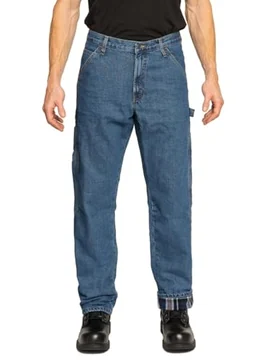
Carpenter Flannel Lined Denim Jeans, Relaxed Fit, Utility Pocket & Hammer Loop, Light Wash, Light Stonewash
Waist 56-60 · 32" inseam · Relaxed fit 4.5 out of 5 (53 for this model) $39.99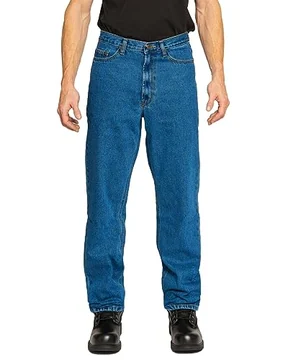
5 Pocket Denim Jeans, Relaxed Fit, Light Wash
Waist 32-60 · 30-36" inseam · Relaxed fit 4.4 out of 5 (437 for this model) $19.99 - $24.99The cargo cut
Cargo trousers move the storage to the side of the thigh, in a bellows pocket with a flap. The plan trades the specialised carrying of the carpenter for general volume: a phone, a tape, a bundle of cable ties, a sandwich.
The cargo plan is the most forgiving of the three and it is why this is the widest part of the range. It works standing, kneeling and driving, and the flap keeps things in when you bend. It is also the only plan that comfortably carries something bulky without it pressing into your leg when you sit.
The cost is weight and hang. A loaded cargo pocket pulls the leg out of line, and two loaded pockets pull it in both directions at once. On a light twill the effect is visible by lunchtime. If you carry heavy things habitually, look for the stretch and heavier canvas versions rather than the lightest twill.
There is a second cost that nobody mentions in a catalogue: cargo pockets snag. On a scaffold or in a plant room the flap finds every protruding bolt. That is not a reason to avoid the cut, but it is a reason to prefer the versions where the flap is stitched down at the sides.
From the range
Cargo pairs, full length and shorts
Carpenter Fleece Lined Canvas Stretch Performance Pants, Regular Fit, Utility Pocket & Hammer Loop, Brown, Dark Brown
Waist 38-44 · 30-34" inseam · Regular fit 4.6 out of 5 (22 for this model) $29.99 - $34.99Carpenter Flannel Lined Denim Jeans, Relaxed Fit, Utility Pocket & Hammer Loop, Light Wash, Light Stonewash
Waist 56-60 · 32" inseam · Relaxed fit 4.5 out of 5 (53 for this model) $39.99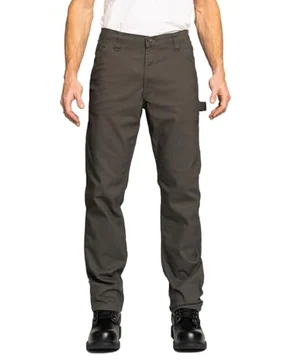
Carpenter Stretch Canvas Pants, Regular Fit, Grey
Waist 34-48 · 30-34" inseam · Regular fit 4.4 out of 5 (240 for this model) $24.99 - $29.99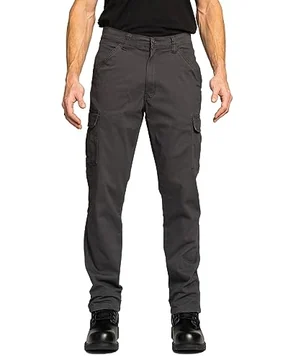
Cargo Stretch Twill Pants, Regular Fit, Grey
Waist 30-50 · 28-34" inseam · Regular fit 4.4 out of 5 (215 for this model) $24.99 - $29.99The five pocket cut
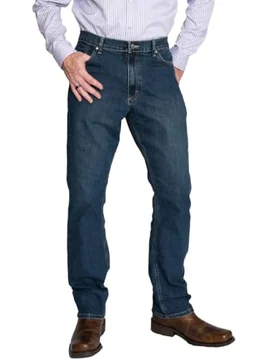
Five pocket is the plan on ordinary jeans: two at the front, two at the back, and the small coin pocket inside the right front. Nothing sits on the outside of the leg at all.
The advantage is that the trousers stay out of the way. Nothing snags, nothing swings, and the pair reads as ordinary clothes rather than as a uniform. For work that mixes a site with a customer's living room, that matters more than any amount of carrying capacity.
The disadvantage is obvious once you try to use it. The front pockets are shallow enough that a phone rides up when you kneel, and the back pockets are the worst possible place for anything hard when you sit in a van. A five pocket pair expects you to carry your tools in a bag or on a belt.
In this range the five pocket cut is also where the washes live. Light, medium, dark, blue black and stonewash all appear here, and the choice is cosmetic rather than functional. Darker washes hide oil and show dust, and lighter washes do the opposite.
Fabric changes the answer as much as the pockets
The same pocket plan behaves differently in different cloth, and this range runs across four: denim, twill, canvas and a small number of ripstop pairs.
Denim is the heaviest and the most forgiving of abrasion. It breaks in rather than wearing out, and it holds a crease badly, which on work trousers is a feature. Twill is lighter, smoother and cooler, and it is what most of the cargo styles here are cut from. Canvas sits between them for weight and is stiffer at the start. a canvas pair takes a fortnight to stop feeling like a tent and then becomes the pair you reach for.
Ripstop is the outlier. There are 1 lines of it here and the grid of reinforcing threads is visible up close. It resists tearing rather than abrasion, which is the right trade for brush and wire and the wrong one for kneeling on grit.
Where the maker adds spandex, the label says stretch, and 32 colourways here carry that word. Stretch is worth most on the cuts that pull across the knee when you crouch, which is all of them, and worth least on shorts.
| Cut | Colourways here | From |
|---|---|---|
| Carpenter jeans and pants | 13 | $14.99 |
| Cargo shorts | 26 | $14.99 |
| Cargo pants | 10 | $24.99 |
| Work shorts | 14 | $14.99 |
| Jeans | 8 | $19.99 |
| Work pants | 7 | $23.99 |
The lined pairs are a different decision
Once the temperature drops, the pocket plan stops being the main question. This range carries 7 lined colourways in three constructions, and they are not the same thing.
Flannel lining is a brushed cotton layer sewn into the leg. It is the mildest of the three, it breathes, and it is the one to pick if you move between a cold yard and a warm cab all day. Fleece lining is warmer and heavier and it holds moisture, which matters if you are working hard enough to sweat in the cold.
The bonded pairs are the interesting ones. Instead of a loose lining sewn in at the seams, the layer is fused to the shell, so the trousers behave like a single heavier fabric rather than like two layers sliding on each other. They are less bulky at the waist and they do not bunch when you pull them on over boots.
What none of the three do is make a pair waterproof. Lining is insulation. One line here is described by the maker as water repellent, and repellent is not proof: it sheds a shower and gives up under a hose.
From the range
Lined and heavier pairs
Carpenter Fleece Lined Canvas Stretch Performance Pants, Regular Fit, Utility Pocket & Hammer Loop, Brown, Dark Brown
Waist 38-44 · 30-34" inseam · Regular fit 4.6 out of 5 (22 for this model) $29.99 - $34.99Carpenter Flannel Lined Denim Jeans, Relaxed Fit, Utility Pocket & Hammer Loop, Light Wash, Light Stonewash
Waist 56-60 · 32" inseam · Relaxed fit 4.5 out of 5 (53 for this model) $39.99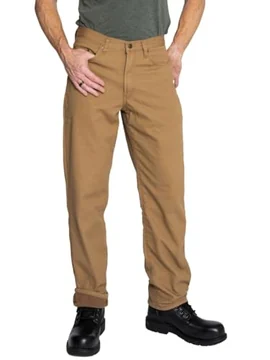
5 Pocket Fleece Lined Twill Pants, Bonded, Relaxed Fit, Hickory
Waist 38-46 · 30-34" inseam · Relaxed fit 4.3 out of 5 (110 for this model) $29.99 - $34.99What the fibre content line tells you, and what it hides
Every pair has a second label behind the care label, and it is the one that says what the cloth is. The rule behind it is worth knowing because it explains why some labels look oddly precise and others look oddly vague.
the respective generic names of all fibers present in the amount of 5 per centum or more of the total fiber weight of the textile fiber product shall be used when naming fibers in the required informationFederal Trade Commission, 16 CFR Part 303, Rules Under the Textile Fiber Products Identification Act, read 12 September 2026
Five percent is the threshold that shapes the whole line. Anything above it must be named, and anything below it does not get a name at all.
no fiber present in the amount of less than 5 percent of the total fiber weight shall be designated by its generic name or fiber trademark in disclosing the constituent fibers in required information, but shall be designated as “other fiber.”Federal Trade Commission, 16 CFR Part 303, Rules Under the Textile Fiber Products Identification Act, read 12 September 2026
In practice that is why a stretch pair reads ninety eight percent cotton, two percent spandex, and why a pair with a trace of something else reads other fiber instead of naming it. Two percent elastane is the ordinary dose for work trousers: enough to take up an inch at the waist and across the knee, not enough to change how the cotton wears.
It also means a fibre line of one hundred percent cotton is a real claim rather than a rounded one. On a cotton pair, expect it to behave like cotton: heavy when wet, slow to dry, and better at abrasion than anything synthetic at the same weight.
Pocket by pocket, what actually fails
Work trousers rarely wear out in the middle of a panel. They fail at four points, and the pocket plan decides which of the four you meet first.
- The hammer loop, at the top stitch, on carpenter pairs. A loop stitched only at the base peels off. One stitched at both ends outlasts the leg.
- The cargo pocket corner, where the bellows folds. This is the point that snags and the point that tears, and it is why the flap shape matters more than the pocket depth.
- The back pocket edge on five pocket jeans, from a wallet or a phone riding against the seam.
- The knee, on everything, from kneeling on grit. No pocket plan helps here. The fabric and the fit do.
The maker names reinforced seams and double stitching as the answer to the first three, and on the pairs here that is visible at the pocket mouths. It is not a guarantee and we are not offering it as one. It is the construction the maker states, and construction is the part of a work trouser worth paying for.
Shorts are a separate decision, not a shortened trouser
Shorts are the largest single block in this catalogue: 26 cargo colourways and 14 plain ones. They are not simply trousers cut off at the knee, and treating them that way leads to buying the wrong length.
The first difference is that a short has no inseam number on the label. What varies instead is where the hem lands, and most working shorts are cut to sit at or just above the knee so that kneeling is possible without the hem folding under the kneecap.
The second is that pocket weight behaves worse. A loaded cargo pocket on a short has less fabric below it to hang from, so it pulls harder at the waistband. If you carry a phone and a tape in the side pockets all day, a short wants a firmer waistband than trousers do, which is one reason so many of the shorts here come with the side elastic waist.
The third is seasonal and obvious, but it changes the cut choice: nothing on a short protects the knee. If the job involves kneeling on anything sharp, the trousers are the answer regardless of the temperature.
The waistband is part of the cut
The three pocket plans say nothing about the waistband, and on this range the waistband is where a lot of the real difference sits. There are three kinds here.
A plain fixed waistband with belt loops is the default and it is what most of the denim carries. It holds a belt properly and it does not move, which is what you want if you hang anything from the belt.
A stretch waistband looks identical and gives about an inch under load. It is the quiet upgrade on a long day in a van, and it is the reason a stretch pair in your usual number often feels a size larger than the plain one.
The side elastic waistband has a panel of elastic at each hip, and 8 colourways here are built that way. It gives about two inches, it makes pulling a pair on over boots easier, and it changes how a belt behaves because the elastic moves and the belt does not. On the largest sizes in this catalogue it is the difference between a pair that fits and a pair that nearly fits.
What none of these cuts do
It is worth being blunt about the edges of this range, because the wrong trousers on the wrong site is a safety question rather than a comfort one.
- Nothing here is flame resistant, and nothing carries an arc rating. If your work requires either, buy the garment that holds the certificate.
- Nothing here is high visibility. There are no retroreflective bands and no fluorescent base fabric.
- Nothing here is cut protective. Chainsaw work needs chainsaw trousers.
- Nothing here is waterproof. Repellent on one line, and that is the whole claim.
That list is short because the range is honest about what it is: ordinary work trousers for ordinary trades, cut roomy and sized further than most. Where a job needs a certificate, the certificate is the product, and no amount of stitching makes up for it.
How the three cuts age
Buy any of these three and in a year they will not look the same as each other, even in the same fabric and on the same person.
A carpenter pair ages at the loop and the patch pocket. The loop frays where the hammer head rubs, and the patch pocket collects a shadow the shape of whatever lives in it. Both are cosmetic for a long time before they are structural, and the pair usually goes at the knee first anyway.
A cargo pair ages at the flap. The top edge of the flap bleaches faster than the leg because it catches the sun, and the corner that snags picks up small pulls that never become holes. The pocket mouth stretches slightly and never comes back, so an old cargo pocket swallows a phone more easily than a new one.
A five pocket pair ages like jeans, which is to say it ages best. The wash lifts at the thigh and the seat, the hem frays where it meets the boot, and the whole thing gets softer. If you want a pair that looks better in two years than it did new, this is the cut that does it, and a darker wash gives you more room to travel.
None of that is a reason to choose, but it is worth knowing before you pay more for a colour. A light wash five pocket shows its age quickly and honestly. a black twill cargo looks new until the day it does not.
Choosing, in one paragraph
If you carry hand tools all day, take the carpenter. If you carry a phone, a tape and odds and ends, take the cargo. If you work in front of customers or spend the day driving, take the five pocket and put the tools in a bag. Then pick the fabric for the season, and pick the size by the method in the measuring guide rather than by the number you remember.